Skip to content


Have you ever stopped while writing and wondered whether the correct spelling is dying or dieing? These two spellings look similar, but only one is correct when you are talking about death.
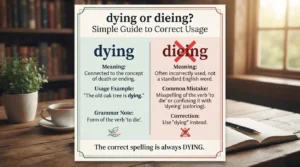
The correct spelling is dying. It is the present participle of the verb die, which means to stop living. Dieing is generally an incorrect spelling and should not be used when referring to death.
For example:
- Correct: The old tree is dying.
- Incorrect: The old tree is dieing.
However, there is another word worth knowing: dyeing. It refers to changing the color of something, such as hair, fabric, or clothing.
Understanding the difference between dying, dieing, and dyeing will help you avoid common spelling mistakes and choose the right word in everyday writing.
Dying or Dieing: The Quick Answer
If you are writing about someone or something approaching death, always use dying.
The word dying follows the spelling rule for verbs ending in a silent e. When you add -ing to die, you remove the final e and add -ing.
Die + ing = Dying
The spelling dieing keeps the original e before adding -ing. That is not the correct spelling of the present participle of die.
| Word | Correct or Incorrect? | Meaning |
| Dying | Correct | The process of approaching or experiencing death |
| Dieing | Incorrect in standard modern English for this meaning | A common misspelling of dying |
| Dyeing | Correct | The process of changing the color of something |
Remember: Dying relates to death, while dyeing relates to color.
What Does Dying Mean?
Dying is the present participle of the verb die. It describes the process of losing life or approaching death.
It can describe people, animals, plants, and other living things. They can also appear in expressions where something is gradually disappearing or becoming weaker.
Here are some examples:
- The doctor said the patient was dying.
- The flowers are dying because they have not received enough water.
- Many people were dying from the disease.
- The old tradition is slowly dying out.
- The fire is dying down.
In everyday English, dying can also be used figuratively. For example, someone might say, “I am dying to know what happened.” This does not mean the person is actually approaching death. It means they are extremely curious.
Is Dieing a Word?
Many people search for “is dieing a word” because they have seen this spelling online or in everyday writing.
In standard modern English, dieing is not the correct spelling of the word meaning approaching death. The correct form is dying.
The confusion happens because people may think that adding -ing to die should produce dieing. However, English spelling rules often require removing the final silent e before adding -ing.
Consider these examples:
| Base Verb | Correct -ing Form |
| Die | Dying |
| Lie | Lying |
| Tie | Tying |
| Write | Writing |
| Make | Making |
| Hope | Hoping |
Notice that the final e disappears before -ing is added.
Therefore, if you are writing about death, use dying rather than dieing.
Why Is It Dying and Not Dieing?
The reason is a common English spelling rule.
When a verb ends in a silent e, you generally remove that e before adding the suffix -ing.
For example:
- Take becomes taking.
- Bake becomes baking.
- Smile becomes smiling.
- Drive becomes driving.
- Die becomes dying.
The word die follows this pattern.
If you wrote dieing, you would be keeping the final e even though it should be removed.
This is why dictionaries and standard English writing use dying rather than dieing for the process of death.
A Simple Way to Remember the Rule
Think about the original verb and what happens when you add -ing.
Die → Dying
The final e disappears, and the letter y remains.
You can use this pattern to remember other words such as lying and tying.
Dying or Dieing for Death: Which One Should You Use?

When talking about death, dying is always the standard spelling.
Whether you are writing about a person, an animal, a plant, or a group of people, the correct form remains the same.
Examples:
- He is dying from a serious illness.
- The patient is dying peacefully.
- The dog is dying of old age.
- Several plants are dying in the garden.
- People are dying because of the dangerous conditions.
You might see dieing in an informal message, social media post, or spelling mistake, but it is not the standard form.
Is It Dying or Dieing for Death?
The answer is dying.
For example:
Incorrect: My grandfather is dieing.
Correct: My grandfather is dying.
Incorrect: The leaves are dieing.
Correct: The leaves are dying.
Whenever the meaning involves death or the gradual loss of life, choose dying.
Dying or Dyeing: What Is the Difference?
One reason people confuse dying and dieing is that another correctly spelled word, dyeing, sounds almost the same.
However, dying and dyeing have completely different meanings.
- Dying: The process of approaching or experiencing death.
- Dyeing: The process of adding color to something.
The word dyeing comes from the verb dye, which means to change the color of an object or material.
Examples of dying:
- The plant is dying.
- The patient is dying.
- The old building is slowly dying.
Examples of dyeing:
- She is dyeing her hair brown.
- They are dyeing white fabric blue.
- I am dyeing my clothes a different color.
Dying vs. Dyeing vs. Dieing
| Word | Meaning | Example |
| Dying | Approaching death | The bird is dying. |
| Dyeing | Changing color | She is dyeing her hair. |
| Dieing | Incorrect spelling for the meaning of death | Avoid this spelling. |
Quick memory trick:
- Dying = Death
- Dyeing = Color
- Dieing = Incorrect spelling in standard English for death
Dieing or Dying Hair: Which Spelling Is Correct?
If you are talking about the process of changing someone’s hair color, the correct word is dyeing.
For example:
- She is dyeing her hair blonde.
- I am dyeing my hair black.
- He is dyeing his hair for a new look.
However, if you are talking about hair that is losing its life or becoming unhealthy, you may use dying in a figurative sense.
For example:
- My hair is looking dull and dying.
This is not the same as changing its color.
The distinction is simple:
- Dyeing hair means applying color.
- Dying hair describes hair that appears to be losing its health or vitality.
Avoid writing “dieing hair” when you mean coloring hair.
Dieing or Dying Clothes: Which Is Correct?
When you are changing the color of clothes, the correct spelling is dyeing clothes.
The verb dye describes the process of adding or changing color in fabric.
Examples:
- She is dyeing her old clothes.
- They are dyeing the fabric blue.
- I want to try dyeing my white shirt black.
- The company specializes in dyeing different types of clothing.
The spelling dying clothes would suggest something completely different and is generally not what you mean when discussing fabric coloring.
Here is an easy comparison:
| Incorrect or Different Meaning | Correct Expression |
| Dieing clothes | Dyeing clothes |
| Dying clothes (when referring to coloring) | Dyeing clothes |
| Dyeing clothes | Changing the color of clothing |
Whenever you are talking about fabric, paint-like color treatments, or clothing color changes, remember to use dyeing.
Dying Meaning in Different Sentences
The word dying has several uses in English. Its meaning depends on the sentence and context.
Here are some common examples.
1. Dying as the Process of Death
This is the most direct meaning of the word.
Example: The injured animal was dying.
It means the animal was approaching the end of its life.
2. Dying as Gradual Disappearance
The word can also describe something that is becoming less common or slowly disappearing.
Example: Traditional methods of communication are dying out.
Here, dying out means becoming less common and eventually disappearing.
3. Dying Down
The expression dying down means becoming weaker, quieter, or less intense.
Examples:
- The noise is dying down.
- The excitement is slowly dying down.
- The wind is dying down.
Do not write dieing down.
4. Dying to Know
The phrase dying to know is an informal expression that means being extremely curious about something.
Examples:
- I am dying to know the result.
- She is dying to know what happened.
- We are dying to know your opinion.
It does not describe actual death.
5. Dying to Go
The expression dying to go means being extremely eager or excited to visit a place or attend an event.
Examples:
- I am dying to go to New York.
- She is dying to go on vacation.
- They are dying to go to the concert.
Again, dying is the correct spelling.
6. Dying Laughing
The phrase dying laughing is an informal expression used when something is extremely funny.
For example:
- I was dying laughing at that joke.
- We were dying laughing during the movie.
It is an exaggerated way of saying that someone was laughing very hard.

He Is Dying: Is This Correct?
Yes, “He is dying” is grammatically correct.
In this sentence, is is a helping verb, and dying is the present participle of die.
The sentence describes someone who is approaching death.
More examples include:
- He is dying from a serious condition.
- He is slowly dying.
- The doctor believes he is dying.
- Everyone is worried because he is dying.
You can use the same structure with other subjects:
- She is dying.
- I am dying.
- They are dying.
- Someone is dying.
- People are dying.
The spelling does not change when the subject changes.
I’m Dying or Dieing: Which One Is Correct?
The correct expression is “I’m dying.”
“I’m” is the contraction of “I am,” so the complete sentence is “I am dying.”
Examples:
- I’m dying to see the new movie.
- I’m dying to know the answer.
- I’m dying from laughter.
- I’m dying of thirst.
In casual conversations, people often use “I’m dying” as an exaggeration. It can express excitement, curiosity, thirst, or intense laughter.
However, when referring to actual death, the word has its literal meaning.
Never write “I’m dieing” when you mean dying.
Dying Synonyms: What Words Can You Use Instead?
The word dying has several synonyms, but the best alternative depends on the meaning of your sentence.
If you are talking about death, you can use words such as:
- Perishing
- Passing away
- Fading
- Succumbing
- Expiring
Some alternatives are more sensitive or formal than others.
For example:
| Word or Phrase | Meaning |
| Passing away | A gentle expression for death |
| Perishing | Dying, often because of danger or hardship |
| Expiring | Coming to the end of life |
| Succumbing | Dying or giving in to an illness or condition |
| Fading | Gradually losing strength or vitality |
If you are using dying in a figurative expression, different alternatives may be more appropriate.
For example:
- Dying to know = Eager to know
- Dying to go = Excited to go
- Dying down = Becoming weaker
- Dying out = Disappearing gradually
Always consider the sentence before choosing a synonym.
Common Mistakes When Using Dying, Dieing, and Dyeing
Even people who write English regularly sometimes confuse these three words.
Here are some mistakes to avoid.
| Incorrect Sentence | Correct Sentence |
| He is dieing. | He is dying. |
| I am dieing to know. | I am dying to know. |
| She is dieing her hair. | She is dyeing her hair. |
| They are dieing their clothes. | They are dyeing their clothes. |
| The flowers are dieing. | The flowers are dying. |
| The noise is dieing down. | The noise is dying down. |
| I was dieing laughing. | I was dying laughing. |
The important thing is to identify the meaning first.
If you mean death, use dying. If you mean changing color, use dyeing.
Frequently Asked Questions
1. Is it dying or dieing?
Dying is the correct spelling when referring to the process of death. Dieing is generally considered a misspelling in standard modern English.
2. How do you spell dying or dieing?
The correct spelling is dying. It is formed by removing the final e from die and adding -ing.
3. Why is it dying and not dieing?
English spelling rules generally require removing the final silent e before adding -ing to a verb. Therefore, die becomes dying.
4. Is dieing a real word?
Dieing is not the standard spelling of the present participle of die. Use dying when referring to death.
5. Is dying correct for death?
Yes. Dying is the correct spelling when describing someone or something approaching death.
6. Is it dyeing or dying hair?
Dyeing is correct when you mean changing hair color. Dying refers to the process of death or can describe something losing its vitality.
7. Is it dying or dyeing clothes?
Dyeing clothes is correct when you mean changing the color of fabric or clothing.
8. Is “he is dying” grammatically correct?
Yes. “He is dying” is grammatically correct and uses the present continuous verb structure.
9. Is “I am dying” correct English?
Yes. “I am dying” is correct English. It can describe approaching death or be used informally to express excitement, curiosity, or laughter.
10. What is the difference between dying and dying out?
Dying usually refers to the process of death. Dying out describes something gradually disappearing or becoming less common.
11. Is it dying down or dieing down?
The correct expression is dying down. It means that something is becoming quieter, weaker, or less intense.
12. What is the difference between dying to know and dying?
Dying to know is an informal expression meaning extremely curious. Dying on its own can refer to the process of approaching death.
13. What is another word for dying?
Depending on the context, alternatives include passing away, perishing, expiring, succumbing, and fading.
14. Is dying spelled differently in British and American English?
No. Dying is the standard spelling in both American and British English. Dieing is not the accepted alternative spelling for this meaning.
Final Verdict: Dying or Dieing?
The correct spelling is dying, not dieing, when you are referring to death.
Remember these three words:
- Dying: The process of approaching death.
- Dyeing: Changing the color of hair, fabric, or clothing.
- Dieing: A common spelling mistake when referring to death.
The easiest way to remember the difference is to connect dying with death and dyeing with color.
Whether you are writing “he is dying,” “I am dying to know,” or “the flowers are dying,” always use the spelling dying.
Choosing the correct word makes your writing clearer, more accurate, and easier to understand.

Caroline Whitaker writes clear, friendly guides on word meanings, texting slang, commonly confused words and spelling. She explains each term in plain language with real examples, so readers can understand it and use it with confidence.